
pulse (an RFID solution)
PULSE RFID for Manufacturing replenishment
PULSE RFID connects empty-bin handling with a replenishment signal to Endries. Built around fasteners and Class-C components, it gives manufacturers an RFID-enabled Kanban approach to consider when manual checks or missed signals make replenishment harder to manage.
How PULSE RFID Works
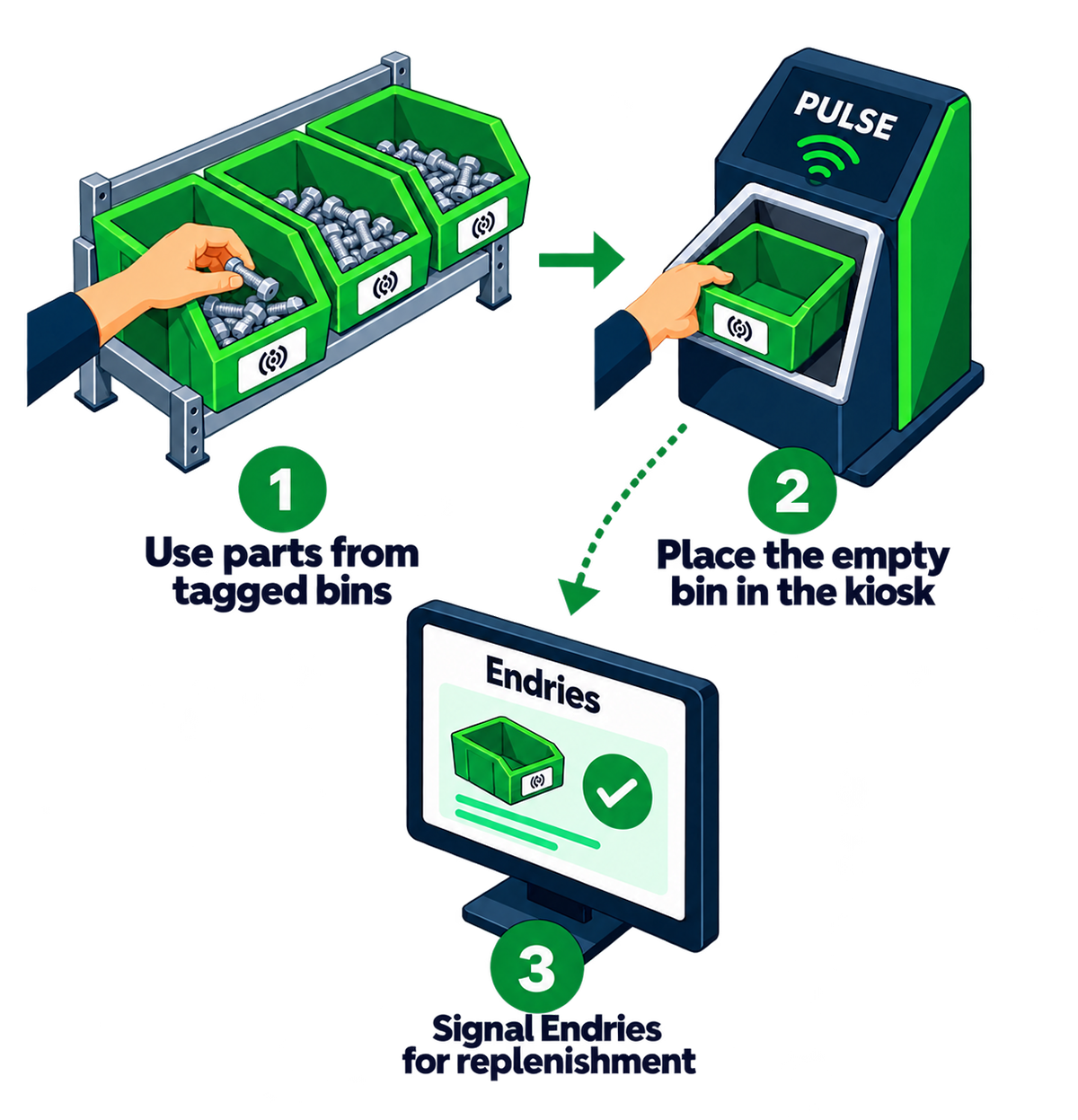
1. Use parts from tagged bins
Parts are stored in bins fitted with radio frequency identification (RFID) tags and used as needed for assembly.
2. Place the empty bin in the kiosk
When a bin is empty, your team places it in the PULSE kiosk. That handling step initiates the replenishment signal.
3. Signal Endries for replenishment
The kiosk reads the tag and signals Endries that the associated product needs replenishment. Order processing and physical delivery follow the arrangements established for your program.
Where Could PULSE Fit Your Operation?
Start with the point where your current replenishment process becomes difficult to manage. Are empty bins waiting for someone to check them? Do signals reach purchasing too late? Are parts stocked in several locations with different usage patterns?
Those questions help establish whether an RFID Kanban approach addresses the problem. Useful areas to review include:

Recurring part usage
Which components are used regularly, and how much does demand change by shift, assembly line, or stocking location?

Empty-bin handling
Who moves empty containers, where do they go, and could kiosk placement fit that daily routine?

Replenishment coverage
How much stock is needed while replacement material is being processed and delivered?

Process ownership
Who maintains part information, communicates demand changes, and follows up when something falls outside the agreed process?
The components behind the process
PULSE’s Kanban-driven technology provides real-time demand insights, reducing excess stock and freeing up valuable manufacturing space.

Bins/kANBAND TECHNOLOGY
Convenient storage bins help organize your inventory.
The trackable bin system ensures your parts are right where you need them, when you need them. And if that weren’t enough, these bins are compact, lightweight and dedicated to one product. Once deposited into the PULSE kiosk, we receive a signal to order more of the very product you need.

rfid TagS
Connect inventory to a robust tracking system.
This reliable technology is backed by a company that knows the value of precision when it comes to product inventory management. Each bin has two matching RFID tags, which are linked to the inventory contained within. The PULSE kiosk reads the RFID tags and a notification is sent to us to ship new product inventory to your facility, so you don’t have to worry — we’ve got you.

PULSE Kiosk
This kiosk collects vital data and generates reports.
This workhorse is on the job 24 hours a day, seven days a week to keep your crew operating at peak performance. With a user-friendly interface, we take the guesswork out of the process. You’ll know right away that your request was received and more product is on the way. Robust PULSE programming ensures you receive exactly the right amount of inventory.
plan your pulse evaluation
Start with the information, responsibilities, and system requirements that matter to your operation.
visibility
Define what your team needs to know, who needs access, and how current the information must be. Discuss reporting, quantities, locations, and discrepancy follow-up.

responsibilities
Agree who returns bins, maintains part information, communicates demand changes, and handles exceptions. Review stocking quantities as usage and lead times change.

system requirements
Bring ERP, network, security, and reporting needs into the conversation early so they can be evaluated before implementation commitments are made.
what information should you have ready?
A high-level overview is enough to start. For a more detailed discussion, gather the following. You may also consider involving materials, purchasing, and operations so the discussion reflects both supply requirements and daily handling. Start with general context through Sales, then agree on an appropriate channel for detailed operational information.
- Part list and clear descriptions
- Usage by shift, line, or location
- Current bin quantities and locations
- Lead times and supplier responsibilities
- Shortage or excess-stock examples
- Plant layout and reporting needs

case study
PULSE in Practice at a Construction Equipment Manufacturer
A construction equipment manufacturer worked with Endries to address recurring shortages and inaccurate inventory records. The program combined PULSE RFID with engineering review, corrections to part information, inventory audits, and local service support.
The case illustrates how replenishment technology works alongside accurate data and clear stocking procedures. It provides a useful example for teams evaluating the operational changes that may accompany a PULSE program.
PRAISE THAT FUELS OUR PROMISE

We have been in a partnership with Endries since 2009 and they are one of our primary fastener suppliers… They We’ve been impressed with the recent implementation of the Endries PULSE system in our facility. Endries proves to be the gold standard in order replenishment. We have seen instant improvement in our inventory tracking, allowing us to easily identify important parts are getting to the right location on our manufacturing floor.
The transition to the PULSE system went very well, and the overall “look and feel” of the bins and rack is impressive. The PULSE system not only provided improved ordering and basically eliminated stock outages, but also helped us identify and eliminate non-moving inventory. And, it provided a clear process to move inventory to the correct location in our assembly area.also have an onsite vendor managed inventory program the entire time and have done a phenomenal job at managing the program.
Project Engineer
Commercial and Industrial Equipment Industry

Frequently Asked Questions
What triggers the replenishment signal?
When your team places an empty tagged bin in the PULSE kiosk, the kiosk reads the RFID tag and signals Endries that replenishment is needed. Order processing and delivery follow the arrangements established for your program.
How are stocking quantities determined?
Stocking quantities should reflect part usage, replenishment lead times, and the material needed between deliveries. Share your current quantities, demand patterns, and shortage history with Endries so those requirements can be reviewed.
What inventory information can our team access?
Discuss your visibility and reporting needs during the PULSE evaluation. Confirm which information is available, how quantities and locations are represented, when updates occur, and who can access it. An empty-bin signal should not be interpreted as continuous counting of individual parts.
Can PULSE work with our existing suppliers or systems?
Bring your supplier arrangements and ERP, network, security, and reporting requirements into the initial discussion. These need to be reviewed for your operation before compatibility, stock responsibilities, or program scope can be confirmed.
Stop the Bottlenecks – Take Control of Your Supply Chain
Streamline operations with our future-ready supply chain solutions. Contact our sales team today to discover how we can reduce costs, improve efficiency, and enhance visibility across your supply chain.